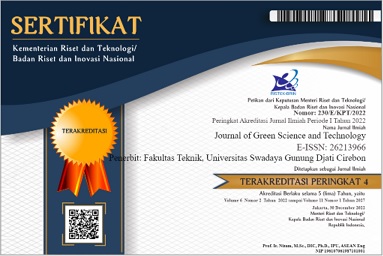
PUBLICATION ETHICS AND PUBLICATION MALPRACTICE STATEMENT
Journal of Green Science and Technology (JGST) is committed to maintaining high standards of publication ethics, academic integrity, transparency, and responsible scholarly publishing. This policy applies to authors, editors, editorial board members, reviewers, and the publisher, and applies to all content published by JGST, including regular issues and special issues.
1. Responsibilities of Authors
Originality and Plagiarism
Authors must ensure that submitted manuscripts are original works and are free from plagiarism, fabrication, falsification, inappropriate data manipulation, and other forms of research misconduct. All ideas, data, figures, tables, and materials originating from other sources must be properly acknowledged and cited.
Multiple, Redundant, or Simultaneous Submission
Authors must not submit the same manuscript simultaneously to JGST and another journal. Manuscripts that have been published previously or substantially overlap with previously published work must not be submitted without appropriate disclosure and justification.
Authorship and Contributorship
Authorship must be limited to individuals who have made substantial contributions to the conception, design, execution, analysis, interpretation, or preparation of the manuscript. All authors must approve the final manuscript and agree to its submission. Contributors who do not meet the criteria for authorship should be acknowledged appropriately.
Accuracy and Research Integrity
Authors are responsible for presenting research data and findings accurately and honestly. Fabrication, falsification, selective manipulation, or intentional misrepresentation of data is unacceptable.
Conflicts of Interest
Authors must disclose any financial, institutional, personal, or other relationships that could reasonably be perceived as influencing the research or interpretation of results.
Funding Disclosure
Authors must disclose all sources of financial support, grants, sponsorship, or other funding related to the research.
Data Availability and Reproducibility
Authors should provide sufficient information to enable the research to be understood and, where appropriate, reproduced. Data supporting the findings should be made available when ethically, legally, and practically possible.
Ethical Approval
Research involving human participants, animals, sensitive personal data, or other activities requiring ethical approval must comply with applicable ethical standards. Authors must provide information about approval from the relevant ethics committee or institutional review body when required.
Copyright and Licensing
Authors retain copyright of their work and grant JGST the right of first publication. Published articles are licensed under the Creative Commons Attribution-ShareAlike 4.0 International License (CC BY-SA 4.0).
Errors in Published Work
Authors who discover a significant error or inaccuracy in their published article must promptly inform the journal and cooperate with the editorial team in correcting or retracting the article where necessary.
2. Responsibilities of Reviewers
Confidentiality
Manuscripts received for review must be treated as confidential documents and must not be disclosed or discussed with unauthorized parties.
Competence and Timeliness
Reviewers should accept review assignments only when they have appropriate expertise and sufficient time to complete the review responsibly.
Objectivity
Reviews must be conducted objectively and constructively. Personal criticism of authors is inappropriate.
Conflicts of Interest
Reviewers must disclose any potential conflict of interest and decline the review when independence or impartiality could reasonably be questioned.
Identification of Ethical Concerns
Reviewers should inform the editor if they identify suspected plagiarism, duplicate publication, data manipulation, inappropriate citation practices, or other ethical concerns.
3. Responsibilities of Editors and the Editorial Board
Editorial Independence
Editorial decisions must be based on the scholarly merit, originality, relevance, methodological quality, and suitability of the manuscript for the scope of JGST. Decisions must not be influenced by commercial considerations, institutional relationships, nationality, gender, religion, political views, or other irrelevant factors.
Confidentiality
Editors must protect the confidentiality of submitted manuscripts and information relating to authors and reviewers.
Conflicts of Interest
Editors and editorial board members must not handle manuscripts where they have a conflict of interest. Such manuscripts must be assigned to another qualified and independent editor.
Integrity of Peer Review
Editors are responsible for ensuring that peer review is conducted fairly, independently, confidentially, and according to JGST's stated peer-review process.
Manuscripts authored by editors, editorial board members, reviewers, or individuals affiliated with the publisher must not receive preferential treatment and must undergo the same independent peer-review process as other submissions.
4. Research Misconduct
JGST takes allegations of research and publication misconduct seriously. Misconduct includes, but is not limited to:
- plagiarism;
- fabrication or falsification of data;
- inappropriate image or data manipulation;
- duplicate or redundant publication;
- citation manipulation;
- undisclosed conflicts of interest;
- inappropriate authorship practices; and
- other serious violations of research integrity.
When misconduct is suspected, the editorial team will assess the available evidence and may request clarification or supporting documentation from the authors. Where appropriate, JGST may contact the authors' institution or other relevant authority. Editorial actions will be taken in accordance with recognized publication ethics guidance.
5. Corrections, Retractions, and Expressions of Concern
JGST is committed to maintaining the integrity of the scholarly record.
A correction may be issued when an error affects part of an article but does not invalidate its main findings.
A retraction may be issued when there is clear evidence that the findings are unreliable because of misconduct or major error, plagiarism, redundant publication, unethical research, or other serious concerns.
An expression of concern may be issued when serious concerns exist but the available evidence is not yet sufficient to reach a final conclusion.
Corrections, retractions, and expressions of concern will remain permanently linked to the original article and will be clearly identified.
6. Complaints and Appeals
Authors, reviewers, readers, and other parties may submit complaints or appeals concerning editorial decisions, publication procedures, ethical concerns, or journal policies.
Complaints and appeals will be handled objectively and, where possible, by an editor who was not directly involved in the matter. Authors appealing an editorial decision should provide clear reasons and supporting information. Appeals do not guarantee that the original decision will be changed.
7. Post-Publication Discussion
JGST supports responsible post-publication discussion and correction of the scholarly record. Readers may communicate substantive concerns regarding published articles to the editorial office.
Where appropriate, the journal may publish corrections, responses, editorial notices, expressions of concern, or retractions.
8. Special Issues
Articles published in Special Issues are subject to the same standards of editorial screening, publication ethics, peer review, originality, and academic quality as articles published in regular issues.
Participation in a conference, seminar, workshop, or other academic event does not guarantee publication in JGST. Manuscripts originating from such events must undergo the journal's normal editorial and peer-review procedures before acceptance.
Editorial responsibility for Special Issues remains with JGST. Any editor involved in a Special Issue must comply with the same requirements concerning confidentiality, conflicts of interest, independence, and research integrity.
9. Artificial Intelligence and AI-Assisted Tools
Authors remain fully responsible for the accuracy, originality, integrity, and validity of all content submitted to JGST.
Generative artificial intelligence or AI-assisted tools must not be listed as authors because they cannot take responsibility for the published work.
If AI-assisted tools are used in preparing a manuscript beyond routine spelling, grammar, language correction, or formatting, authors must transparently disclose the tool used and the purpose of its use.
Authors must verify all AI-generated or AI-assisted content, including factual statements, references, data interpretation, and conclusions. AI tools must not be used to fabricate data, references, images, or other research content.
Reviewers and editors must not upload confidential manuscripts or unpublished research material to external generative AI systems when doing so could compromise confidentiality, intellectual property, or data protection.
10. Ethical Oversight
JGST expects all research to comply with relevant ethical, legal, institutional, and professional requirements. This includes appropriate protection of human participants, animals, personal data, confidential information, and vulnerable populations where applicable.
11. Publisher and Editorial Responsibility
The publisher and editorial team are responsible for supporting editorial independence and maintaining the integrity of the journal. Commercial, institutional, or other external interests must not influence editorial decisions.
JGST follows recognized principles of transparency and best practice in scholarly publishing and refers to guidance from the Committee on Publication Ethics (COPE) and the Principles of Transparency and Best Practice in Scholarly Publishing.