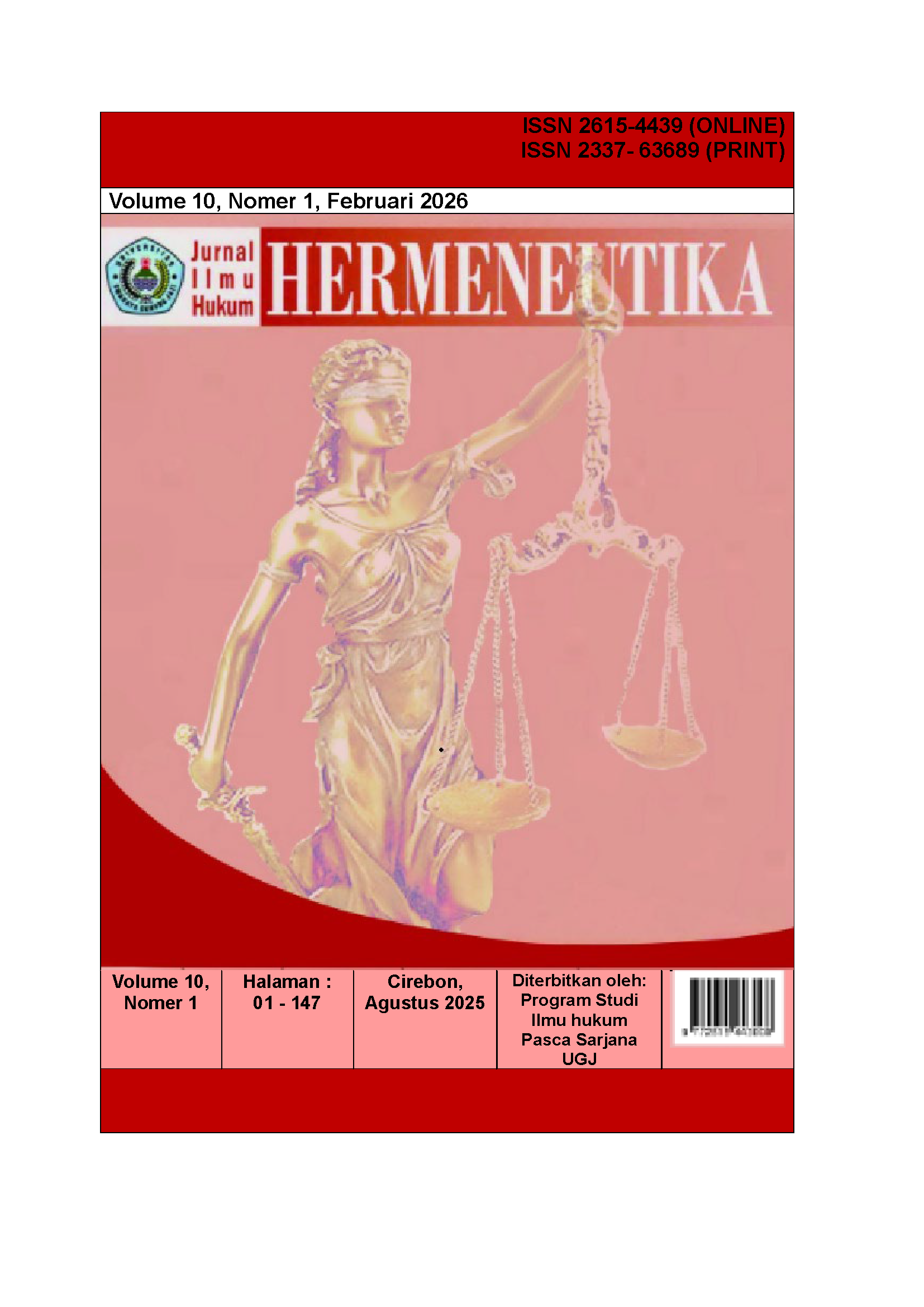
KAJIAN HUKUM ODONTOLOGI FORENSIK UNTUK IDENTIFIKASI KORBAN BENCANA ALAM DALAM PERSPEKTIF KEMANFAATAN HUKUM
DOI:
https://doi.org/10.33603/hermeneutika.v10i1.11317Kata Kunci:
odontologi forensik, identifikasi korban, DVI, kemanfaatan hukum, odontogramAbstrak
Identifikasi korban bencana merupakan bagian penting dalam penanganan pascabencana untuk memastikan terpenuhinya hak korban dan keluarga atas kepastian identitas. Indonesia sebagai negara yang rawan bencana membutuhkan sistem identifikasi yang efektif dan sesuai standar internasional. Odontologi forensik merupakan salah satu metode identifikasi primer yang diakui oleh Interpol karena memiliki tingkat keandalan tinggi, terutama ketika tubuh korban mengalami kerusakan ekstrem seperti terbakar, terdekomposisi, atau tidak dapat diidentifikasi secara visual. Meskipun demikian, sejumlah kasus bencana di Indonesia menunjukkan bahwa pemanfaatan odontologi forensik belum optimal dan tidak terdokumentasi secara memadai.
Penelitian ini bertujuan untuk menganalisis aspek regulasi yang mengatur peran odontologi forensik dalam identifikasi korban bencana serta mengevaluasi kemanfaatan hukumnya. Selain itu, penelitian ini mengkaji norma hukum terkait penulisan dan penggunaan odontogram universal sebagai instrumen penting dalam proses identifikasi berbasis gigi. Metode penelitian menggunakan pendekatan hukum doktrinal dengan paradigma positivisme hukum serta dianalisis menggunakan teori utilitarianisme Jeremy Bentham untuk menilai sejauh mana manfaat hukum dapat diwujudkan melalui penerapan odontologi forensik.
Hasil penelitian menunjukkan bahwa Indonesia telah memiliki landasan hukum yang cukup kuat terkait kewajiban identifikasi korban, namun implementasinya masih terkendala oleh keterbatasan sumber daya ahli, minimnya kesadaran aparat penegak hukum, serta ketiadaan sistem odontogram nasional yang seragam. Kesimpulannya, kemanfaatan hukum dari penerapan odontologi forensik dalam identifikasi korban bencana belum tercapai secara optimal, sehingga diperlukan pembaruan regulasi, peningkatan kapasitas kelembagaan, dan penguatan sistem rekam medis gigi secara nasional.
Referensi
Avon, S. L. (2004). Forensic odontology: The roles and responsibilities of the dentist. Journal of the Canadian Dental Association, 70(7), 453–458.
Berketa, J. (2019). Forensic Odontology and Disaster Victim Identification. CRC Press.
Bowers, C. M., & Bell, G. L. (2016). Forensic Dentistry. Elsevier.
Bushby, S., & Verrill, C. (2020). The role of forensic evidence in global disaster victim identification. Forensic Science International, 315, 110432.
Cameron, J. M., & Sims, B. G. (2018). Forensic Dentistry: An Essential Guide. Wiley-Blackwell.
Cattaneo, C. (2007). Forensic anthropology: Developments of a classical discipline in the new millennium. Forensic Science International, 165(2–3), 185–193.
Creswell, J. W., & Creswell, J. D. (2018). Research Design: Qualitative, Quantitative, and Mixed Methods Approaches. Sage.
De Boer, H., Van Der Lugt, C., & Vos, W. (2021). Digital dental records in forensic identification: Global standards and challenges. Journal of Forensic and Legal Medicine, 84, 102251.
Donnelly, J. (2013). Universal Human Rights in Theory and Practice (3rd ed.). Cornell University Press.
Dorion, R. B. J. (2011). Bitemark Evidence: A Color Atlas and Text. CRC Press.
Ellingham, S. T. D., Thompson, T. J. U., & Islam, M. (2015). Estimating temperature exposure of burnt remains by colorimetric analysis. Science & Justice, 55(1), 10–17.
INTERPOL. (2018). Disaster Victim Identification Guide. INTERPOL General Secretariat.
International Committee of the Red Cross (ICRC). (2019). Management of Dead Bodies After Disasters: A Field Guide for First Responders. ICRC.
Kaur, R., Singh, A., & Dhillon, G. (2020). Dental records and their role in forensic identification. Journal of Forensic Odontology, 38(1), 22–28.
Kelsen, H. (1960). Pure Theory of Law. University of California Press.
Kemenkes RI. (2022). Pedoman Rekam Medis dan Manajemen Informasi Kesehatan. Jakarta.
Lain, R., Taylor, J., Butler, J., & Nambiar, P. (2020). Advances in forensic odontology identification techniques. Australian Journal of Forensic Sciences, 52(4), 452–465.
McKenna, C. J., Barton, S., & Dyer, W. (2017). Improving postmortem dental identification using digital imaging technology. Journal of Forensic Radiology and Imaging, 9, 35–42.
Marzuki, P. M. (2013). Penelitian Hukum. Kencana.
Merlati, G., Savio, C., Danesino, P., Fassina, G., & Miotti, A. (2002). Observations on dental structures when placed in high temperature conditions. Journal of Forensic Sciences, 47(3), 601–604.
Morgan, O. W., Sribanditmongkol, P., Perera, C., Sulasmi, Y., Van Alphen, D., & Sondorp, E. (2006). Mass fatality management following the Asian tsunami: Case studies in Thailand, Indonesia, and Sri Lanka. PLoS Medicine, 3(6), e195.
Mundorff, A., & Vidoli, G. (2015). The DVI process: Legal and ethical issues in mass fatality management. Forensic Science Policy & Management, 6(3–4), 81–93.
Perry, R. W., & Lindell, M. K. (2003). Preparedness for emergency response. Disasters, 27(4), 336–350.
Pretty, I. A., & Sweet, D. (2001). A look at forensic dentistry. British Dental Journal, 190(6), 359–366.
Pretty, I. A., & Sweet, D. (2010). Forensic dentistry: A comprehensive review. Journal of Forensic Sciences, 55(6), 1502–1508.
Prabowo, Y. A., & Rukmini, T. (2020). Analysis of the effectiveness of DVI protocols in major disasters in Indonesia. Indonesian Journal of Health Law, 6(2), 112–129.
Putri, A., & Hidayat, R. (2021). Challenges of dental medical records in forensic identification. Indonesian Journal of Dentistry, 8(2), 124–133.
Putri, D., & Satria, A. (2021). The role of dental medical records in supporting DVI identification. Forensic Health Journal, 5(1), 45–55.
Indonesian National Police Medical Center. (2019). DVI Implementation Guidelines. Indonesian National Police.
Raz, J. (1979). The Authority of Law. Clarendon Press.
Soekanto, S. (2006). Introduction to Legal Research. UI Press.
Stimson, P. G., & Mertz, C. A. (2017). Forensic Dentistry (2nd ed.). CRC Press.
Thali, M. J., Viner, M. D., & Brogdon, B. G. (Eds.). (2011). Brogrdon's Forensic Radiology (2nd ed.). CRC Press.
Sukendro, D., et al. (2025). Analysis of the implementation of forensic odontology in mass accidents. Journal of Forensic and Medicolegal Studies, 11(1), 77–92.
Sutaryo, & Putra, D. (2020). Barriers to DVI implementation in a disaster context. Journal of Health Policy, 13(3), 198–210.
Sweet, D. (2010). Forensic dental identification. Forensic Science International, 201(1–3), 3–12.
Tamanaha, B. Z. (2001). A General Jurisprudence of Law and Society. Oxford University Press.
Indonesian National Police DVI Team. (2024). Indonesia DVI Annual Report 2024. Jakarta.
UNDRR. (2015). Sendai Framework for Disaster Risk Reduction 2015–2030. United Nations.
Law of the Republic of Indonesia Number 17 of 2023 concerning Health.
Government Regulation of the Republic of Indonesia Number 28 of 2024 concerning the Implementation of the Health Sector.
Regulation of the Chief of the Indonesian National Police Number 12 of 2011 concerning Police Medicine
Unduhan
Diterbitkan
Terbitan
Bagian
Citation Check
Lisensi
Hak Cipta (c) 2026 Whildy Audhia Rifdah, Endang Sutrisno, Sri Primawati Indraswari

Artikel ini berlisensiCreative Commons Attribution-ShareAlike 4.0 International License.
The Authors submitting a manuscript do so on the understanding that if accepted for publication, copyright of the article shall be assigned to Jurnal HERMENUTIKA, Sekolah Pascasarjana Ilmu Hukum. Universitas Swadaya Gunung Jati as publisher of the journal. Copyright encompasses rights to reproduce and deliver the article in all form and media, including reprints, photographs, microfilms, and any other similar reproductions, as well as translations.
Jurnal HERMENEUTIKA, Universitas Swadaya Gunung Jati and the Editors make every effort to ensure that no wrong or misleading data, opinions or statements be published in the journal. In any way, the contents of the articles and advertisements published in Jurnal HERMENEUTIKA are the sole responsibility of their respective authors and advertisers.