Analysis of Mathematical Communication Ability of High School Students on the Circle Material
DOI:
https://doi.org/10.33603/jshr.v5i1.11873Keywords:
: Mathematical Communication, Circles, Student Analysis, Mathematics LearningAbstract
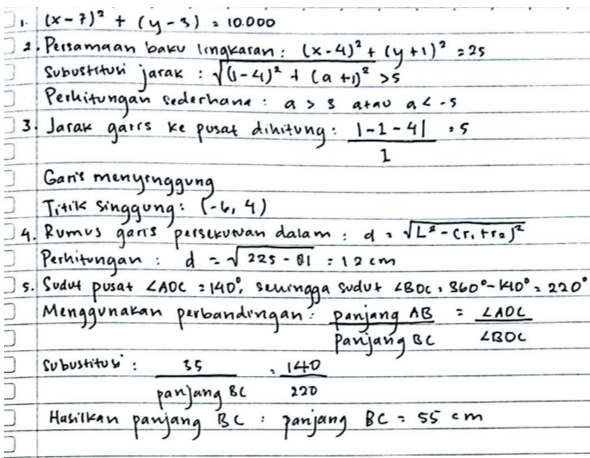
This study analyzed high school students' mathematical communication skills on circle problems based on three categories: high, medium, and low. The research method used was qualitative with a descriptive approach. Data were collected through written tests and interviews to determine students' understanding and how they communicated their thinking processes in solving circle problems. The results showed that students with high ability were able to answer correctly and explain systematically. Students in the medium category understood most of the concepts but were less coherent in their explanations. Meanwhile, students in the low category had difficulty understanding the concepts and explaining their answers. These findings emphasize the importance of mathematical communication in mathematics learning. Therefore, it is recommended that learning emphasize discussion and the delivery of ideas to improve student understanding.
References
Agustyaningrum, N., & Widjajanti, D. B. (2013). Pengaruh Pendekatan CTL dengan Setting Kooperatif Tipe Kancing Gemerincing terhadap Kemampuan Komunikasi Matematis, Kepercayaan Diri, dan Prestasi Belajar Matematika Siswa SMP. PYTHAGORAS Jurnal Pendidikan Matematika, 8(2), 171–180. https://doi.org/10.21831/pg.v8i2.8946
Amatul Wahid, L., & Rina Marlina. (2022). Analisis Kesalahan Siswa Dalam Menyelesaikan Soal Kemampuan Komunikasi Matematis Pada Materi Relasi Dan Fungsi. Didactical Mathematics, 4(1), 138–147. https://doi.org/10.31949/dm.v4i1.2004
Asfar, A., Asfar, A., Aspikal, A., & Nurwijaya, S. (2019). Efektivitas Case Based Learning (CBL) Disertai Umpan Balik Terhadap Pemahaman Konsep Siswa. Histogram : Jurnal Pendidikan Matematika, 3(5), 29–45. https://doi.org/10.31100/histogram.v3i1.293
Fitriani, A. N., & Hidayati, N. (2022). SISWA SMA PADA MATERI PROGRAM LINIER. 5(4), 1033–1040. https://doi.org/10.22460/jpmi.v5i4.1033-1040
Hatip, A., & Setiawan, W. (2021). Bruner’s Cognitive Theory in Mathematics Learning. PHI: Jurnal Pendidikan Matematika, 5(2), 87.
Maryati, I., Suzana, Y., Harefa, D., & Maulana, I. T. (2022). Analisis Kemampuan Komunikasi Matematis dalam Materi Aljabar Linier. Prisma, 11(1), 210. https://doi.org/10.35194/jp.v11i1.2044
Nuraeni, R., & Luritawaty, I. P. (2016). Mengembangkan Kemampuan Komunikasi Matematik Siswa melalui Strategi Think Talk Write. Mosharafa: Jurnal Pendidikan Matematika, 5(2), 101–112. https://doi.org/10.31980/mosharafa.v5i2.386
Octviani, E., & Noor Aini, I. (2022). Analisis Kemampuan Komunikasi Matematis Siswa SMA. Jurnal Ilmiah Fakultas Keguruan Dan Ilmu Pendidikan, 8(1), 84–92.
Rahmah, N. (2013). Hakikat pendidikan matematika. Al-Khwarizmi: Jurnal Pendidikan Matematika Dan Ilmu Pengetahuan Alam, 1(2), 1–10.
Riswandha, S. H., & Sumardi, S. (2020). Komunikasi Matematika, Persepsi Siswa Pada Mata Pelajaran Matematika, dan Kemandirian Belajar terhadap Hasil Belajar Matematika. Jurnal Mercumatika : Jurnal Penelitian Matematika Dan Pendidikan Matematika, 4(2), 84–93.
Safira, P., Junaidi, & Saputra, H. (2015). PENERAPAN MODEL PEMBELAJARAN CASE BASED LERANING (CBL) UNTUK MENINGKATKAN KEMAMPUAN BERPIKIR KREATIF SISWA SM SMA Putri Safira 1 , Junaidi 2 , Hery Saputra 3. 28–33.
SanononiSarumaha, K., Sarumaha, R., & Gee, E. (2022). ANALISIS KEMAMPUAN KOMUNIKASI MATEMATIS SISWA PADA MATERI SPLDV DI KELASVIII SMPN 3 MANIAMOLOTAHUN PEMBELAJARAN 2020/2021. 1(12), 2439–2450.
Siagian, M. D. (2016). Kemampuan koneksi matematik dalam pembelajaran matematika. MES: Journal of Matematics Education and Science2, 2(1), 58–67.
Siagian, M. D. (2017). Pembelajaran Matematika Dalam Persfektif Konstruktivisme. NIZHAMIYAH: Jurnal Pendidikan Islam Dan Teknologi Pendidikan, VII(2), 61–73.
Sugiyamti, S. (2018). Peningkatan Hasil Belajar Membuat Skets Grafik Fungsi Aljabar Sederhana Pada Sistem Koordinat Kartesius Melalui Metode Cooperatif Learning Jigsaw Pada Siswa Kelas Viii F Smp Negeri 6 Sukoharjo Semester I Tahun Pelajaran 2017/2018. Jurnal Ilmiah Edunomika, 2(01), 175–186. https://doi.org/10.29040/jie.v2i01.195
Susilawati, W. (2020). Belajar Dan Pembelajaran Matematika. In Cv. Insan Mandiri.
Wulandari, N. S., & Ekawati, R. (2023). Komunikasi Matematis Siswa SMP dalam Menyelesaikan Soal PLSV ditinjau dari Tipe Kepribadian Extrovert dan Introvert. MATHEdunesa, 12(2), 434–449. https://doi.org/10.26740/mathedunesa.v12n2.p434-449
Downloads
Published
How to Cite
Issue
Section
Citation Check
License
Authors who publish with this journal agree to the following terms:
- Authors retain copyright and grant the journal right of first publication with the work simultaneously licensed under a Creative Commons Attribution License that allows others to share the work with an acknowledgement of the work's authorship and initial publication in this journal.
- Authors are able to enter into separate, additional contractual arrangements for the non-exclusive distribution of the journal's published version of the work (e.g., post it to an institutional repository or publish it in a book), with an acknowledgement of its initial publication in this journal.
- Authors are permitted and encouraged to post their work online (e.g., in institutional repositories or on their website) prior to and during the submission process, as it can lead to productive exchanges, as well as earlier and greater citation of published work.




 JSHR (Journal Socio Humanities Review) is licensed under a